Personalize experiences with user properties
Use user properties to dynamically insert personalized content into your content
Table of Contents
Once you're sending user properties to Appcues, you can reference them inside any Flow to customize text, images, URLs, and more. Common use cases include greeting users by name, showing their account manager's details, linking to dynamic URLs with a user ID, or loading images based on plan type.
User properties only. Personalization supports user properties. Group properties are not supported.
Use the user data picker
- Open a Flow step in the builder and click into a text field.
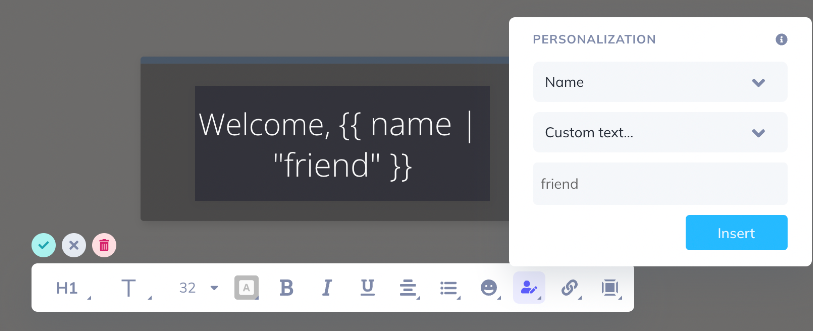
- Click the person icon in the text toolbar. A dropdown lists all available user properties.
- Select a property. Appcues inserts it in
{{propertyName}}format.
The variable resolves to real data only when a user sees the Flow live. It does not resolve in the builder preview. Use Test mode or a permalink to verify personalization with real user data.

Add a fallback value
A fallback displays when the selected property has no value for a given user.
- After selecting a property from the picker, choose a fallback option from the list.
- To enter custom text, scroll to the bottom and select Custom text…, then type your fallback.
- To skip the fallback, select No fallback. If the property is empty, nothing displays in its place.
Insert variables manually
In experience types or Appcues Mobile where the property picker isn't available, type the variable directly using double curly braces:
{{name}}
{{userId}}
The property name must match exactly what appears on your user properties settings page. Capitalization matters, and there should be no spaces between words inside the braces.

To add a fallback manually, use the pipe character and a value in double quotes:
Hi {{ name | "there" }}!If name has a value, the user sees "Hi Alice!" If not, they see "Hi there!" The fallback is a direct replacement — it always displays when the property is empty (the surrounding text stays as-is).
Pass user data into embedded forms
You can use personalization variables inside embedded form URLs to pre-fill fields or identify respondents. The general pattern:
- Set up URL parameters (hidden or visible) in your external form tool.
- Use
{{propertyName}}syntax in the embed URL inside your Flow to pass values from Appcues.
See Embed a Typeform in an Appcues Flow for a step-by-step walkthrough. Typeform and SurveyMonkey also have their own guides on identifying respondents (Typeform) and tracking respondents (SurveyMonkey).
Privacy and security
Appcues content is published to your page, so the contents of a published Flow are retrievable by anyone who can load the page. If you use personalization to display sensitive data, that data could be accessed by someone who knows the user's ID.
Choose user IDs that are difficult to guess. Avoid user IDs that could be found online, like email addresses.
If you don't want personalization available in your account, contact support@appcues.com.